10.2 Discussion
Nation, Archaeology, Genetics
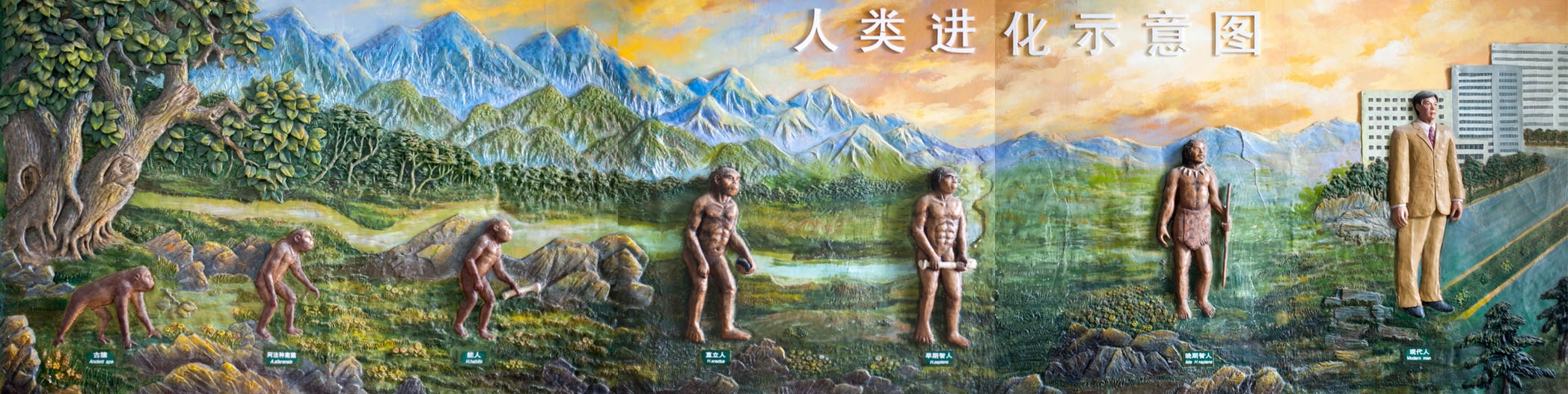
Diagram of human evolution, Zhoukoudian Peking Man Site, Beijing.
Today
- Welcome to Nina Jablonski and George Chaplin.
- Build on previous discussion on the roots of Chineseness, in science as well as popular discourse in China.
- Synthesize evidence and implications on the evolution of skin color to with the question nation and history.
Guest speakers
Nina Jablonski
Evan Pugh Professor Emeritus of Anthropology, Pennsylvania State University
George Chaplin
Lecturer and Senior Research Associate, Pennsylvania State University
The search for genetic origins
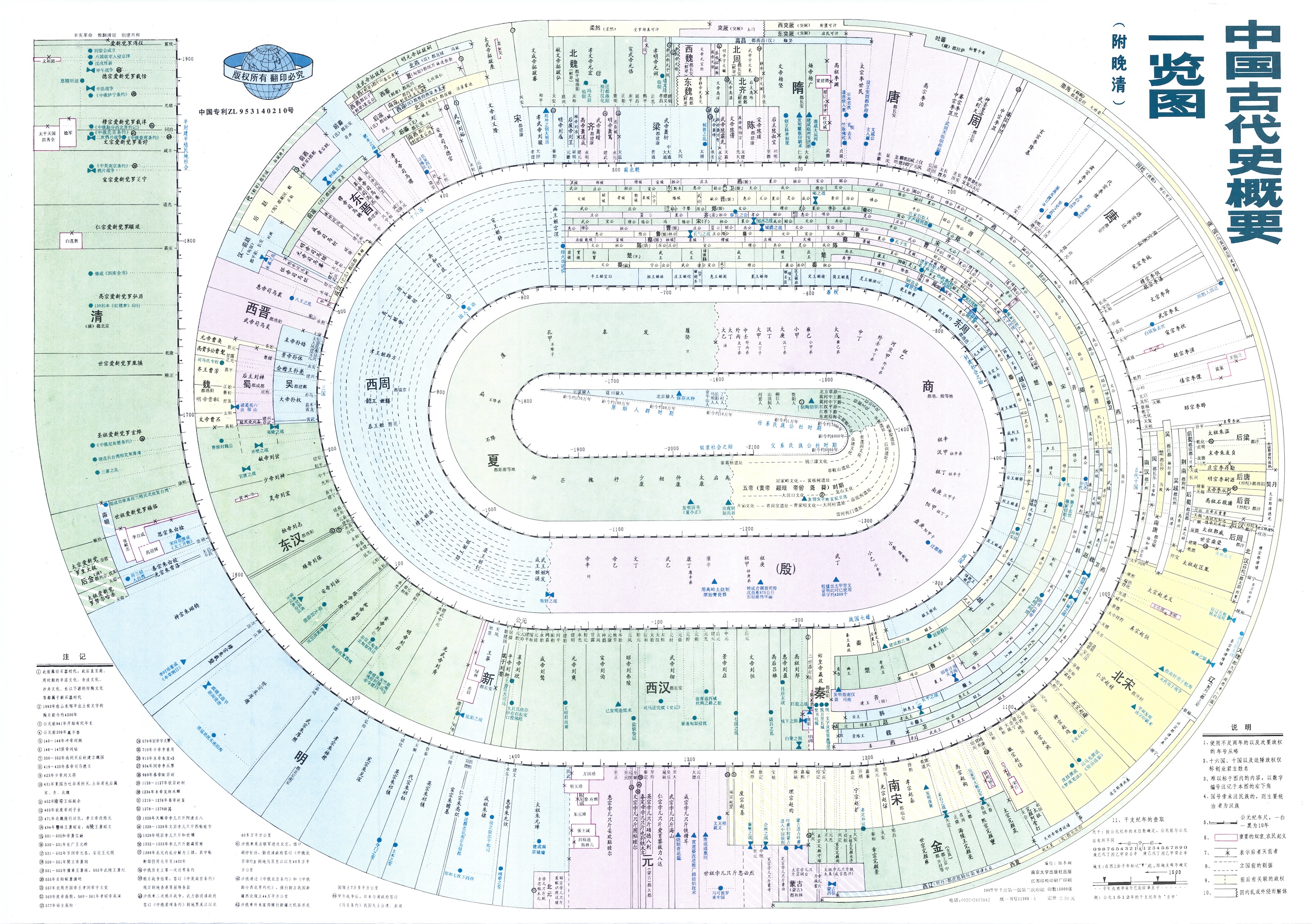
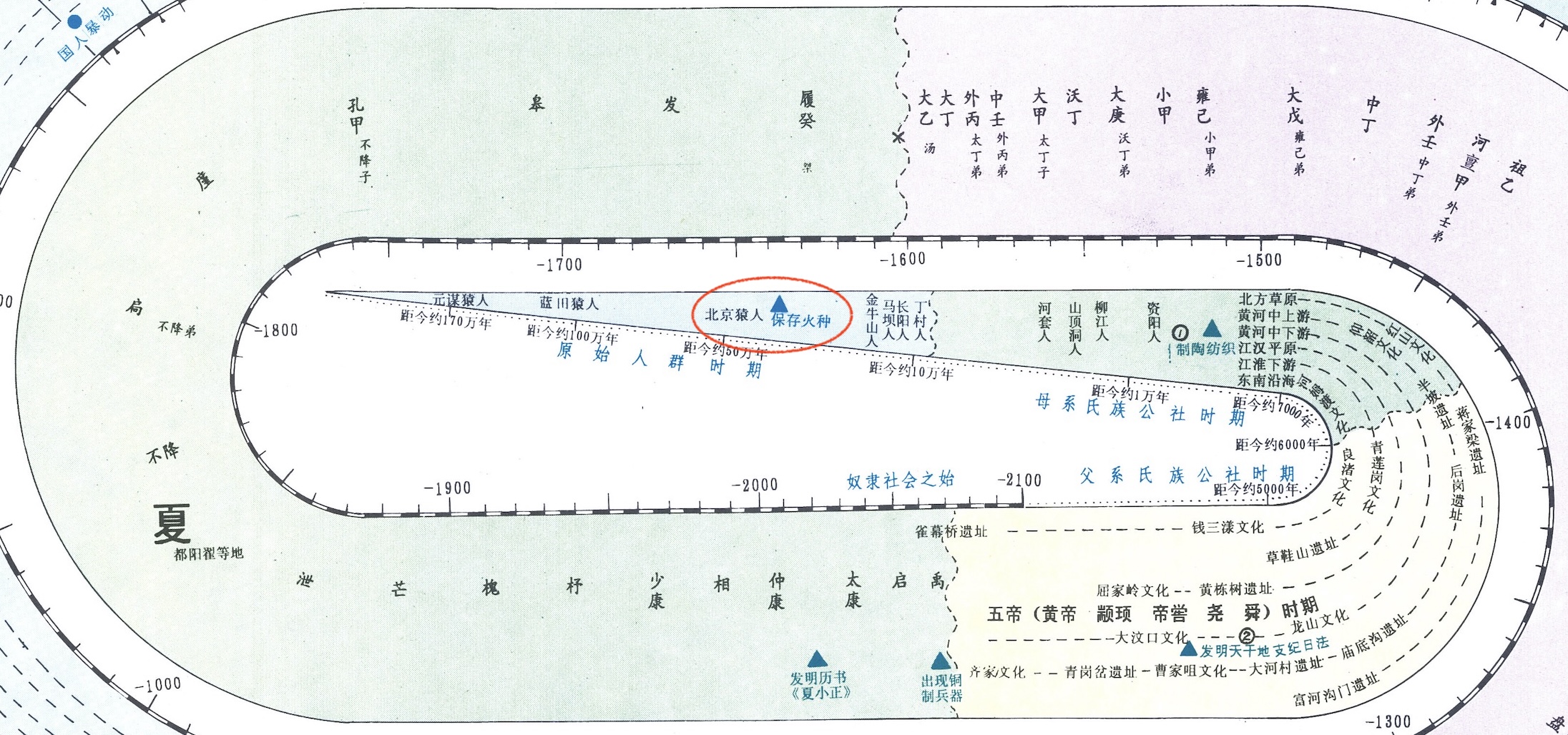
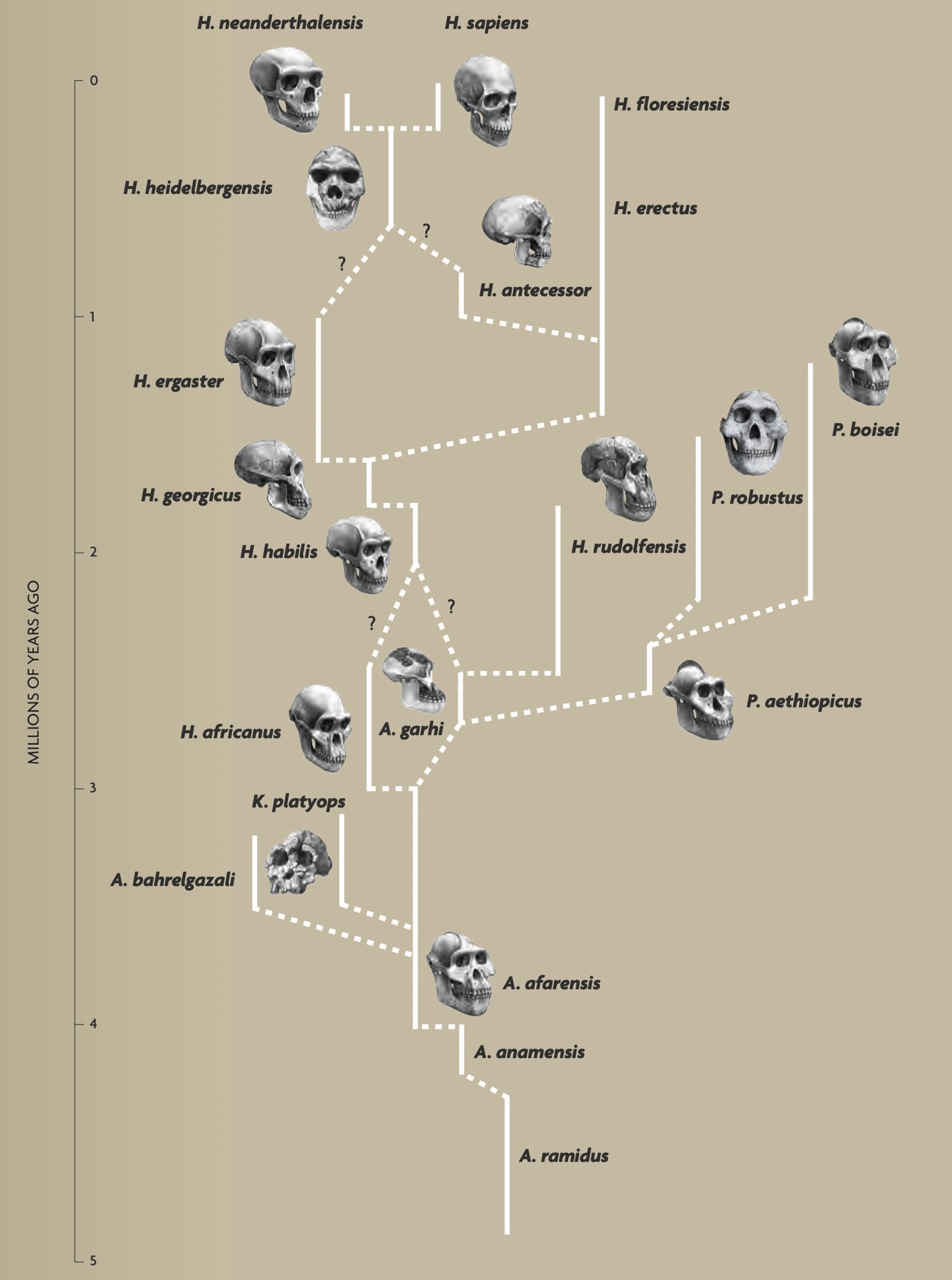
Migration from Africa →
- H. erectus (1.7 m.y.a.) and H. sapiens (70-125,000 y.a.) both migrated
- early humans lived in China for hundreds of thousands of years
- modern Chinese (Han?) have some genetic links to early modern humans
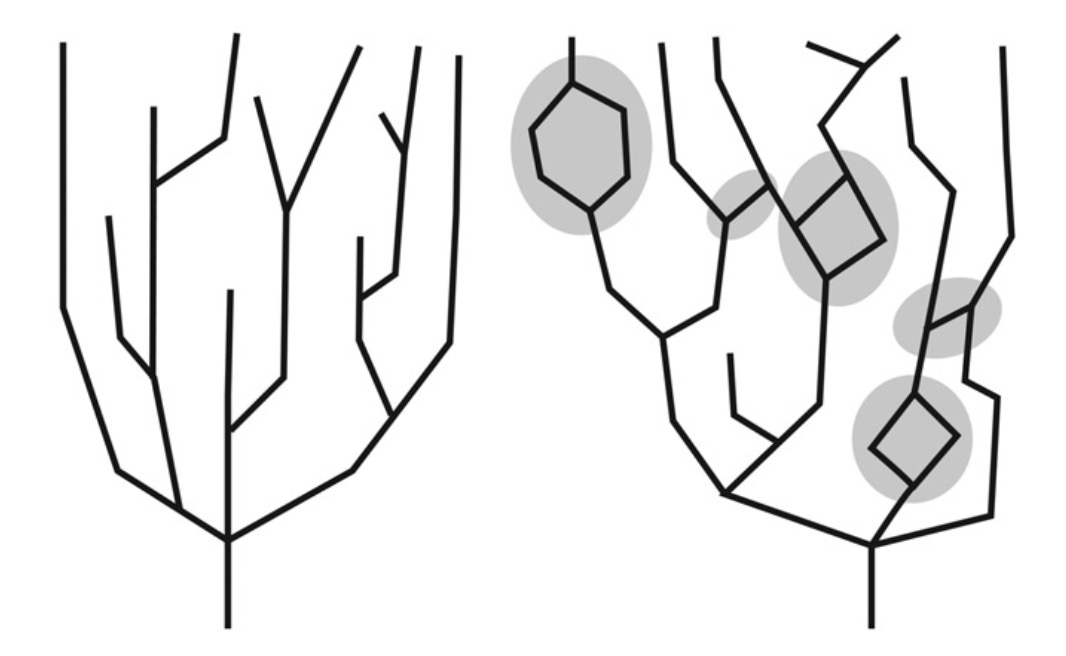
- multiple waves, mixing, regional evolution
What took place between ≈100,000 and ≈50,000 y.a.?
- AOC: modern H. sapiens migrated out of Africa and completely replaced earlier hominid populations (H. erectus) globally; no direct biological descendants among modern humans from Peking Man
- COC: continuous local evolution from Homo erectus through regional evolution to modern Chinese, with minor mixing with “foreign” H. sapiens groups
← Modern humans mix in East Asia
- ≈40,000 y.a. to now
- more archaeological and genetic evidence for human history (sparser earlier)
- ≈6000-8000 y.a. more
- Neolithic mixing shapes modern genetic diversity
“Homo Sinensis” and the Geo-Body
Quick look at the state claim and an expression of what we might call China’s ancestral geo-body.
Untangling racial nationalism
Key passage from Cheng (2017):
…racial nationalism in China, epitomized in physical and biological claims such as “descendants of Yan and Huang emperors,” “descendants of the Dragon” (a totemic veneration of the dragon as a divine ancestral animal god patronizing China), yellow as the primordial pigment of the skin, the River, the yellow earth, and the imperial legacy, as well as Peking Man as the national ancestor.
Just as the glorification of Peking Man has recently developed into an instrument for patriotic mobilization, the racial nationalism discussed above has become more accessible in society and therefore more popular owing to the invention of new rhetoric and dissemination devices. For example, “black eyes, black hair, and yellow skin,” a set of blatant racial taxonomies, has been employed in popular culture and everyday language with official acquiescence to denote “Chineseness.” It has almost become the synonym of “Chinese people,” along with the existing “descendants of the Dragon” and “descendants of Yan and Huang emperors.” “Chinese heart and Chinese blood,” another set of less racial but biologically evocative concepts, has been popularized to essentialize the source of the common belonging for the national unity and a diasporic Chineseness. The most public presentation of these “racial boundary markers” can be found in officially promoted “patriotic songs” created since the 1980s as a major popular culture instrument for nationalist mobilization, with the most acknowledged ones included in the DPCCP list of the “One Hundred Patriotic Songs”…to celebrate the PRC’s sixtieth anniversary. Their titles and lyrics address Chinese identity in passionate as well as melancholy tones, often filled with a sense of the Chinese as a race with an entrenched nationalist grievance….
The political appropriation of COC has extended the application of these concepts from the ethnic and cultural (measured in thousands of years) to the evolutionary and biological (measured in hundreds of thousands of years). Cultural continuity has been transformed into racial genealogy. A “Chinese identity” finds its ultimate origin not only in an H. erectus ancestry but also in an asserted harmony between this hominid and the natural setting. The two fuse into a habitat alien to foreigners from which “motherland/fatherland” (the land is ancestrally “ours”) and “Chinese territory since the antiquity” acquire absolute legitimacy. In the final analysis, a racial myth of a million-year-old exuberant bioenergy, called the “vigorous vitality and incomparable creativity,” as the current Chinese president reiterated, has become a catchphrase that distinguishes superior “Chinese” from “Others”… (596–97)
Key conclusions from Jablonski and Chaplin (2000):
In this paper we demonstrate that the previously observed relationship between skin pigmentation in indigenous human populations and latitude is traceable to the strong correlation between skin color and UV radiation. We also present evidence supporting the theory that variations in melanin pigmentation of human skin are adaptive and that they represent adaptations for the regulation of the effects of UV radiation on deep strata of the integument. (58)
As the density of body hair decreased and the density of sweat glands increased, the need for protection of subepidermal tissues against the destructive effects of UV radiation, particularly UVB, also increased. This protection was accomplished by an increase in melanization of the skin. 59
We argue here that protection against nutrient photolysis, and specifically photolysis of folate, was a prime selective agent which brought about the evolution of deeply pigmented skins among people living under regimes of high UVB radiation throughout most of the year because of the direct connection between folate and individual reproductive success. The importance to individual fitness of protection of sweat glands and maintenance of thermoregulatory capability is also seen as contributing to increased melanization. 61
Cultural practices have had significant effects on rates of change of integumentary pigmentation in human populations that have undergone migrations, especially in the last 20,000 or so years. 79
Perhaps most relevant to our discussion of race and nation:
The results of this study suggest that skin pigmentation is relatively labile, and that adaptations to local UVMED conditions can occur over relatively short periods of geological time. Thus, it is likely that some human lineages through time may have gone through alternating periods of depigmentation and pigmentation (or vice versa) as they moved from one UVMED regime to another…. Because of its high degree of responsiveness to environmental conditions, skin pigmentation is of no value in assessing the phylogenetic relationships between human groups. (80)
Paths for discussion
- What might we (re)consider in the AOC versus COC debate, and in that late Paleolithic period (above)? How much of the question is legitimate hypothesis or an evidence-based question?
- How does the science skin color challenge concepts of race.
- For the class, how does the science of skin color challenge support for racial nationalism?
- How should we take scientific consensus and popular public opinion? Science itself has, after all, been used to confirm racial discrimination.
Wrap up
- We meet on Sunday, same time and place (Legislative Day for Thursday schedule)