Synthesis Writing
One of the most important elements of academic writing is the synthesis of other writers’ ideas into your own. But what is synthesis writing, and how is it done?
Synthesis means generating new, meaningful ideas
Synthesis writing is a type of source-based writing that requires writers to synthesize the information from different sources into a new and meaningful text.
—Vandermeulen, Van Steendam and Rijlaarsdam (2023)
Your goal in synthesis writing is to generate and communicate new, meaningful ideas. This goes beyond simply summarizing or paraphrasing multiple texts, or integrating direct quotes from multiple sources. It even goes beyond the compare-and-contrast essays we were trained to do when first learning to write using multiple sources.
You’re not synthesizing your sources unless you’re generating ideas of your own. This means you are reading and thinking with your own purposes in mind. Synthesis is new intellectual territory made by you.
Well-synthesized writing can be visualized
It may be helpful to look at examples of what well synthesized writing looks like. One place to look is in the reading assignments for class – most journal articles, for example, include at least a short section where the author discusses (and cites) the work of other authors with the primary goal of building up her own position.
Another example of well synthesized writing comes from an analysis of student papers (McGregor 2011). This report highlighted the citations, quotations, and paraphrasing that referred to other authors’ ideas, and left the students’ original work unhighlighted. Here you can see the visual differences between well-synthesized writing (A) and unsynthesized/plagiarized writing (D) (text intentionally blurred):
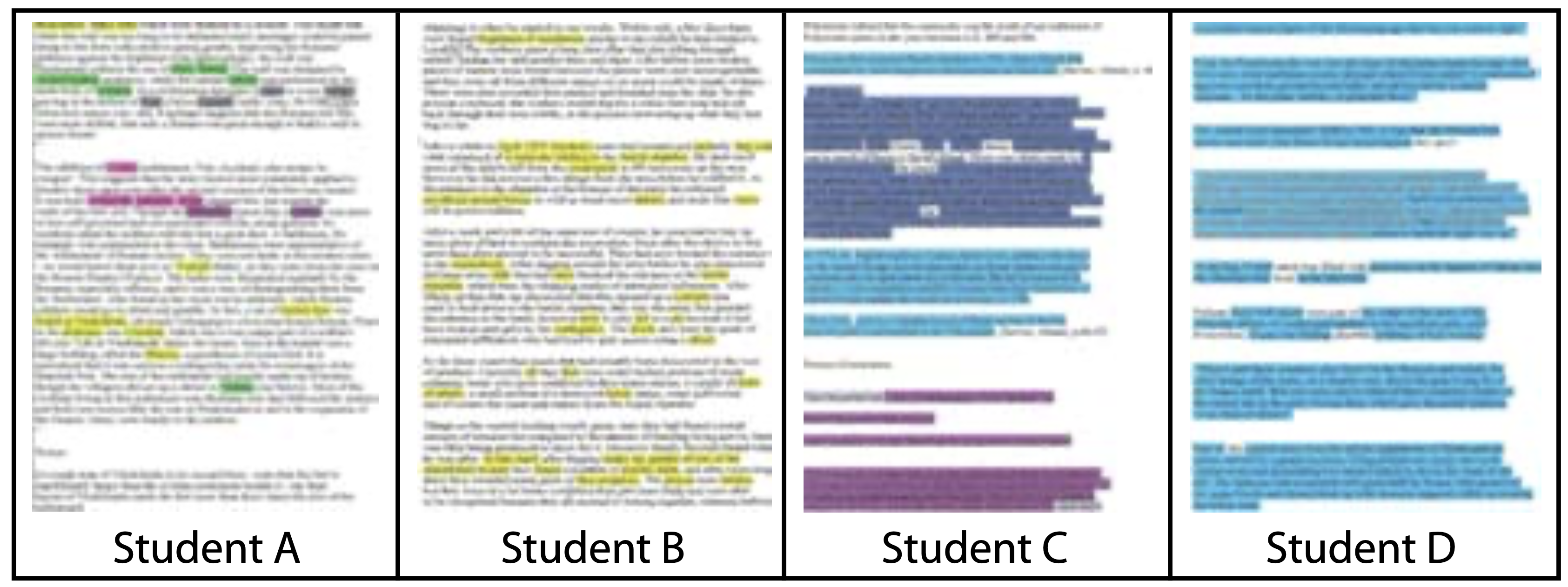
- Student A: substantial original writing, multiple sources (at least 5 here), cited material is concise, limited, and well-distributed
- Student B: substantial original writing, one source, cited material is concise and fairly well distributed
- Student C: minimal original writing, multiple sources (3), heavily reliant on other writers’ ideas (likely plagiarism), substantial cited material
- Student D: effectively no original writing, one source, heavily reliant on other writer’s ideas (likely plagiarism), substantial cited material
These patterns tell us something about how these students constructed their writing, and about what writing a good synthesis looks like in the end.
Good synthesis takes practice
Here are some strategies1 that may help at different points in the process:
- Choose good sources. Start with peer-reviewed academic research, and cite other credible sources as necessary to support your ideas.
- Read and understand your sources. You cannot synthesize what you don’t understand. What is the problem each text is concerned with? What thesis or argument does each text make? What evidence or data is supplied?
- Invest time in your individual texts early in the process. The later stages of organizing and writing your synthesis will be much easier if you’ve invested time and effort in your sources early.
- Know why you’re synthesizing your sources. To know what is useful in each text, you need to know what need from them. Your thesis or argument may not be clear until you’ve worked through your sources, but actively seek the thread that will tie it all together.
- Get organized. Synthesis, potentially, requires a lot of material from a lot of sources. You’ll need your sources, notes on each, and a way to keep track of the material you’re synthesizing.
- Get visual. Outlines, graphs, and tables that visualize relationships in your sources can be very helpful.
- Document your sources. You will cite your sources as you write up your synthesis. Make it easy on yourself by keeping track of page numbers and references. Consider using the Citations tool in Google Docs, or a more advanced reference manager such as Zotero.
- Plan to work recursively. Phases of reading and writing will recur and repeat throughout this process. Keep notes, write in small chunks, work through multiple iterations toward your synthesis.
- Paraphrase well. Don’t rely on direct quotes to express yourself.
- Remember, this is your synthesis. Your writing should stand on its own; your sources are there to help you on your way.
Write about sources in a way that supports synthesis
Generating original ideas from existing sources is easier once you’ve communicated what those sources are saying. It might be helpful to use some common patterns and formulas as you discuss your sources.
The “Referring to sources” section of the Academic Phrasebank is an excellent resource for the kinds of phrases and sentence structures common to English language academic writing.
The sections on “synthesizing material” are helpful in discussing multiple sources, but this is different than the broader goal of synthesizing all of your references into new, meaningful ideas of your own. At some point you will depart from discussing existing work and develop your own ideas. The visualization of Student A’s writing above is worth keeping in mind.
Another helpful resource for writing with sources is the book They Say/I Say (Graff and Birkenstein 2017).
Revise your paragraphs to support your synthesis
As you write and revise your work, check that you are doing more than simply discussing sources.
Have a look at your paragraphs and check that they:
- develop your own ideas rather than simply report what others have said,
- relate your sources to one other and to your thesis,
- advance, step-by-step, an original argument built from an analysis of sources,
- include only the most relevant details from sources, with an explanation how or why they are relevant,
- are organized around concepts or themes rather than individual sources,
- communicate a story or conversation across sources (rather than a series of unrelated summaries), and/or
- identify gaps, inconsistencies, or new questions raised by examining multiple sources together.
Literature Reviews
The literature review is, in essence, a synthesis. A literature review serves a specific purpose. It might help establish the historical background of a project, provide context for a theoretical concern, or – often – establish the significance of a research project. But the goal of reviewing what has already been done is nearly always to support doing something else, something new and meaningful that previous work hasn’t addressed.
I recommend reading Writing a Literature Review (Purdue Online Writing Lab) and Literature Reviews (UNC Chapel Hill) for more guidance on writing a literature review.
Well-Synthesized Notetaking
Consider extending these ideas to the notes you keep on your reading and research. If your notes are heavy on cut-and-pasted quotes from other authors, they might look something like Student D’s work. So long as you’ve kept track of the source(s) of your quotes, this is better than having no notes. But this is not yet your own material.
Building synthesis writing into your notetaking would transform your notes into something closer to Student C (more sources) and Student B (more of your own material), and eventually begin to look like Student A. This can take increased investment in time now, but notes that are useful to you, that help you do something in the future (like a capstone project or graduate degree) are precious resources.
References
Graff, Gerald, Cathy Birkenstein, Russel K. Durst, and Laura J. Panning Davies. 2024. “They Say / I Say” : The Moves That Matter in Academic Writing with Readings. Sixth edition. New York, NY: W.W. Norton & Company.
McGregor, Joy. 2011. A Visual Approach: Teaching Synthesis. School Library Monthly, 27(8): 5-7.
Vandermeulen, Nina, Van Steendam, Elke, and Rijlaarsdam, Gert. 2023. Introduction to the special issue on synthesis tasks: where reading and writing meet. Reading and Writing, 36(4): 747–768.
Footnotes
Drawn from material in Vandermeulen, Van Steendam and Rijlaarsdam 2023↩︎