China Gazetteer: Annotated Bibliography
This assignment is designed to help you develop the research foundation for your essay. You will use literature search, comparison, and annotation to refine your research topic and begin identifying the academic literature that will fuel your essay ideas and argument.
You must write in the Google Doc template provided in the Google Classroom assignment.
1. Read the Synthesis Writing guide
Review the synthesis writing guide before beginning. As you work, focus on what the individual academic sources say, how these sources relate to one another, and what new ideas these sources begin to generate for you.
2. Draft an introduction paragraph
In the Google Doc template, draft a short paragraph (<200 words) revising your Topic Idea. It should introduce:
- your place;
- the geographic problem or process you are investigating;
- the analytical approach you’re taking (your “line”).
You may also include a provisional argument or hypothesis if your research is beginning to suggest one, though this is optional.
Your paragraph should reflect what you learn after the Topic Idea assignment, and it’s possible you’ll substantially revise your original topic.
4. Organize at least 10 academic sources into research areas
Through literature searching and reading, list a minimum of 10 peer-reviewed academic studies, mainly journal articles, that are directly relevant to your research problem. You will need to search and skim more than 10 sources before choosing the ones you annotate.
Format all references in Chicago Author-Date style.
Organize your sources under research area headings, with at least 2 sources under each. Your headings should help you organize the scholarly conversation rather than simply categorize sources or broadly outline a topic.
For each research area, write a summary sentence explaining how this group of literature addresses your research problem.
5. Annotate your sources and identify anchor sources
Write a concise 2–3 sentence annotation for each source that does the following:
- Describes & analyzes: What question or problem does the source address (PS)? What argument does it make (ARG)? What evidence supports that argument (EV)?
- Evaluates: What is especially useful, distinctive, or limited for your research? What does this source contribute to your research problem? What matters about this source’s approach to place, concepts, method, or evidence?
- Connects: How does this source change your project, vocabulary, question, or understanding of other sources?
Annotations need to do more than simply say a source is “relevant” or “useful.”
A citation manager such as Zotero can support collection, organization, annotation, and bibliography generation.
As you work through this process, mark 2 to 3 anchor sources in bold to indicate those works especially useful for understanding the scholarly conversation, discovering key terminology, or locating additional sources.
6. Draft a mini synthesis matrix
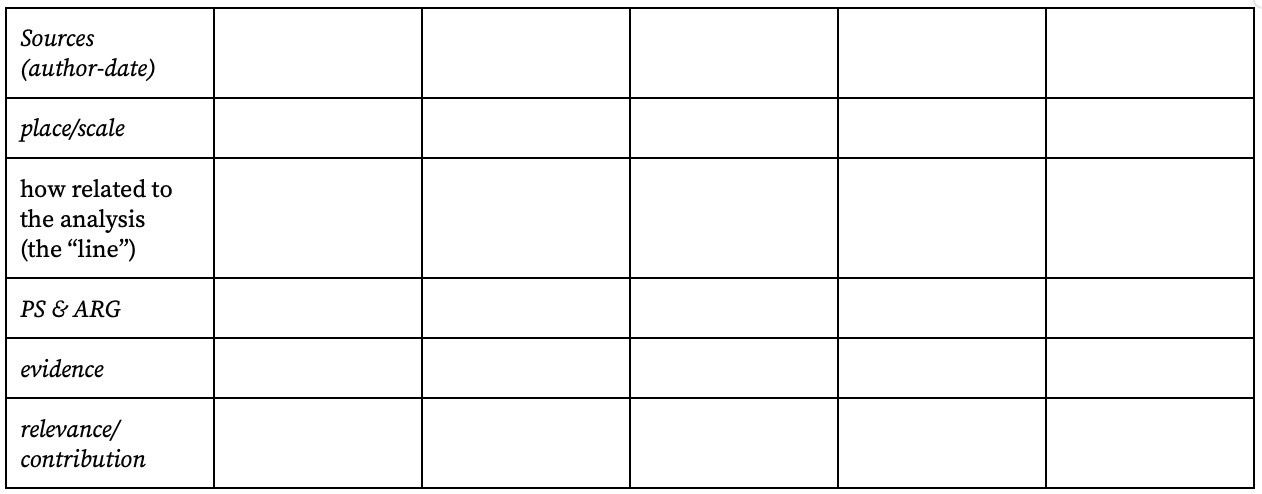
Using at least 5 of your sources, especially your anchor sources, fill in as much of the synthesis matrix (in the template) as you can. Keep entries brief. The goal is to compare sources, not repeat your annotations.
Not every source will have material relevant for every row, and you do not need to be comprehensive in detail. Gaps are expected. This is meant to be a starting point for thinking systematically across sources.
Here is a preview:
7. Use AI carefully, if you choose to use it
You may use permitted AI-assisted research tools for tasks such as:
- identifying search terms;
- locating relevant or related literature;
- extracting structured information from a source.
You are still responsible for following the course AI use guidelines. AI must not be used for:
- reading or translating original sources;
- writing annotations or other content;
- checking AI-generated claims against sources;
- citing the original sources in place of AI output.
8. Submit your Google Doc
Submit the completed Google Doc to the Google Classroom assignment.