Writing & Citing
Writing in this course is a process of thinking. Your aim as a writer is not to produce technically perfect text, certainly not the kind perfect and boring slop generated by AI tools. Your aim as a writer should be to develop your thinking, to use the process of putting words on a page as a method for learning. It is expected that your first drafts will show misunderstandings, imperfections, and errors, and that revisions will be improved.
Be sure to review the AI Use guideline in the syllabus.
Google Docs
We will use Google Docs exclusively for course assignments. I realize you may have your own preferred software, but Google Docs provides a number of tools necessary for course assignments:
- provides sharing and collaboration
- tracks feedback and version tracking tools
- handles multimedia
- manages citations (if desired)
- works seamlessly in Google Classroom
Do not cut and paste into your document, especially if you are revising an assignment. I rely on version tracking to see how your work is developing, and pasting in a whole new paper wipes out the history.
Use the styles set in the assignment templates. Do not change fonts, formatting, or add a cover page: just your name, NetID, course, and semester. This is to keep to a standard format for us all to read and provide feedback on.
Citation Style
Use Google Docs Citation tool and Chicago Author-Date (17th ed.) style (see screenshot at right).
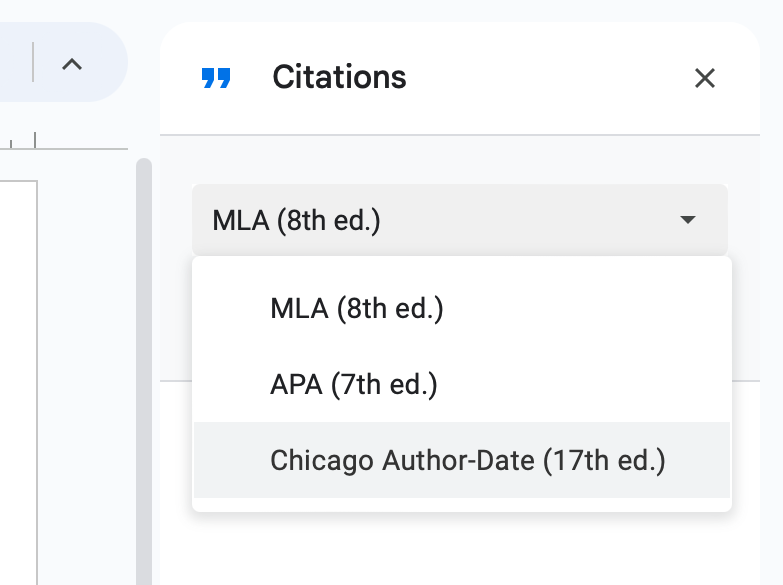
Google will handle citation formatting for you, but here a a concise summary for Chicago author-date style.
Citing Chinese sources
For Chinese language sources, please use pinyin, characters, and an English translation in this general format:
Pinyin 中文 [English]
For example:
| author | Hua, Linfu 华林甫 |
| title | “Qingdai yilai Sanxia diqu shuihan zaihai de chubu yanjiu” 清代以来三峡地区水旱灾害的初步研究 [A preliminary study of floods and droughts in the Three Gorges region since the Qing dynasty] |
| publisher | Zhongguo shehui kexue 中国社会科学 |
Here are two complete examples:
Hua, Linfu 华林甫. 1999. “Qingdai yilai Sanxia diqu shuihan zaihai de chubu yanjiu” 清代以来三峡地区水旱灾害的初步研究 [A preliminary study of floods and droughts in the Three Gorges region since the Qing dynasty]. Zhongguo shehui kexue 中国社会科学 1: 168–79.
Hao, Chunwen 郝春文. 1998. Tang houqi wudai Songchu Dunhuang sengni de shehui shenghuo 唐后期五代宋初敦煌僧尼的社会生活 [The social existence of monks and nuns in Dunhuang during the late Tang, Five Dynasties and early Song]. Zhongguo shehui kexue chubanshe 中国科学出版社.