5.1 Research Workshop
Today
- Review the topic idea assignment and break it down for iterative searching.
- Discuss research literature as a network of relationships (references, citations, related work).
- Explore methods of organizing structured information about readings, and demo an AI-assisted approach to extracting this information.
Reading
Key concepts
- iterative searching
- anchor sources
- references vs citations
- synthesis matrix
- extracting structured information (AI)
From Topic Idea to search terms
Topic Idea review
- Review the course assessment rubric
- A few comments:
- Be careful of posing research questions before you’ve identified a problem needing analysis.
- You won’t have an accurate sense of the research literature until you’ve defined your problem.
- If you’re struggling to find directly related research, consider triangulating your problem in areas of related research.
- This assignment may be revised and resubmitted within 2 weeks.
Topic Idea discussion
Share your Topic Idea document on your screen, and take turns “interviewing” each other with the following questions (2 minutes each). As you interview your partner keep notes on the search terms you would use to begin researching this topic.
- Problem: What problem or phenomenon are you studying?
- Place: Where?
- Time: When? What period or change over time?
- Actors: Who is involved?
- Biophysical factors: What physical or biological/ecological factors are involved?
- Human factors: What political, economic, cultural, or social factors are involved?
- Power: Who or what causes, shapes, or changes the phenomenon? Why is this happening?
It is completely fine to be stumped by some of these. They’re just aimed at getting you thinking about things you might not have considered yet.
Search term comparison
Share the search terms you collected from your interview. Take a moment to answer any questions about the suggestions (1 minute each).
Think about how you might further break down your topic idea into researchable parts.
Research as iterative inquiry
Each search is a chance to refine your project and learn how to better search effectively for it. After each search ask, “What language does the literature use that I did not use?”
Search operators can be very useful:
| Google Search operators | Operator | Google Search example |
|---|---|---|
| Search for an exact phrase | "…" | "urban heat island" |
| Exclude a word or phrase | - | gentrification -tourism |
| Search for either term | OR | gentrification OR displacement |
| Require both concepts | AND | housing AND displacement |
| Restrict results to a website or domain | site: | climate migration site:un.org |
| Restrict results by file type | filetype: | housing displacement filetype:pdf |
| Require a term in the page title | intitle: | intitle:gentrification displacement |
| Require a term in the URL | inurl: | inurl:report climate migration |
| Restrict results to pages before a date | before: | housing policy before:2020 |
| Restrict results to pages after a date | after: | urban heat after:2022 |
| Group terms when combining operators | ( ) | ("short-term rentals" OR Airbnb) AND (displacement OR gentrification) |
Try deliberately different formulations, for example:
Airbnb AND gentrification
"short-term rentals" AND displacement
platform economy AND housing AND touristification
Iterative searching
Complete three successive Google Scholar searches, beginning with new or revised terms from the previous exercise. The goal here is not to collect anything, but rather to learn how your problem or topic is being discussed in previous research.
Complete the handout as you do your three searches.
Flag a few especially good search terms for the next step (concepts, places, events, other evidence). Keeping notes on the process may be helpful later if you do come across something you think is useful.
Identify at least one source that looks most useful to your topic and note the title (an “anchor” source).
The experimental Google Scholar Labs might be worth exploring. Google Scholar Quick Read links might be useful in skimming results.
From search results to anchor sources to citation networks
A anchor source is one article, book chapter, or other scholarly work that is genuinely close to your topic, and that might provide an opening for an important scholarly discussion.
Once you find an anchor article, skim it strategically, read its abstract and introduction, inspect its keywords and concepts, and inspect its references.
What can you steal from it that would help improve your searching?
Scholarship is a network
- References (backward links)
- What other sources does this source cite?
- Citations (forward links)
- What sources later cited this source?
- Related (similar material)
- What related authors, concepts, journals, places, or methods appear around this source?
ResearchRabbit is helpful in visualizing these relationships rather than presenting only a flat list of search results.1 Here is a short intro video for using ResearchRabbit, and a getting started guide.
Optional: Use a reference manager
If you’re looking for a way to manage a lot of references (and stop formatting things by hand), consider these options:
- Use the Google Docs Citation tool directly in your document.
- Use Zotero with the Google Docs plugin. (Beware this can be tricky on occasion.)
- Ask an AI tool to format your references list.
The course standard citation style is Chicago Author-Date (17th ed.).
From citation networks to synthesis
Review the Synthesis Writing guide.
Collecting and reading a pile of PDFs is not yet a literature review. Take a systematic approach to understanding their connections to help you develop your ideas.
Synthesis matrix
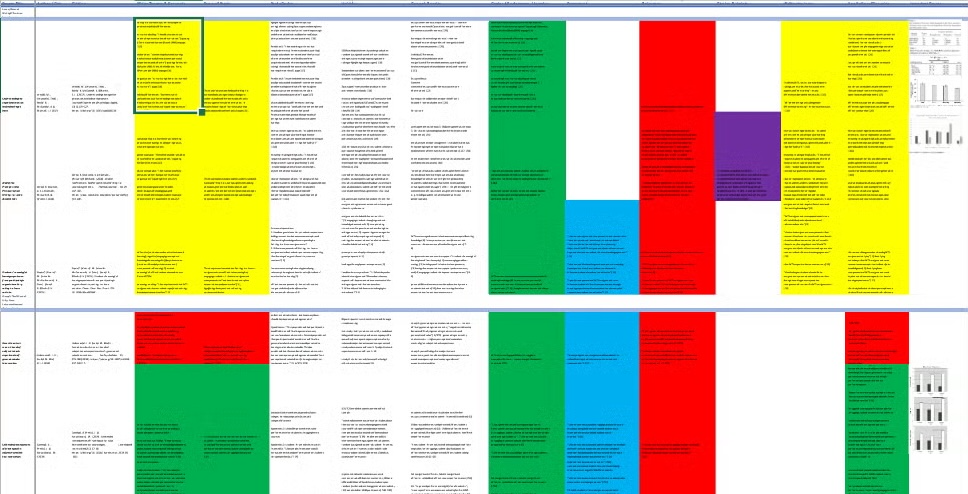
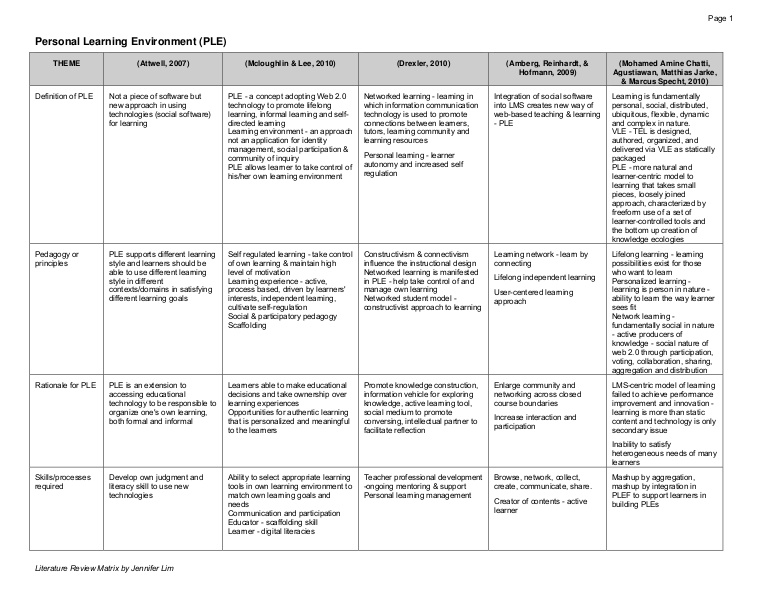
One useful tool is to create a synthesis matrix, basically a table of sources and key themes, concepts, methods, findings, or questions that makes it easier to identify patterns and relationships across the literature. Your columns should reflect what is useful for your own analysis and argument.
This example, pictured above, demonstrates a process of moving from a synthesis matrix to a written outline.
Here is another example:
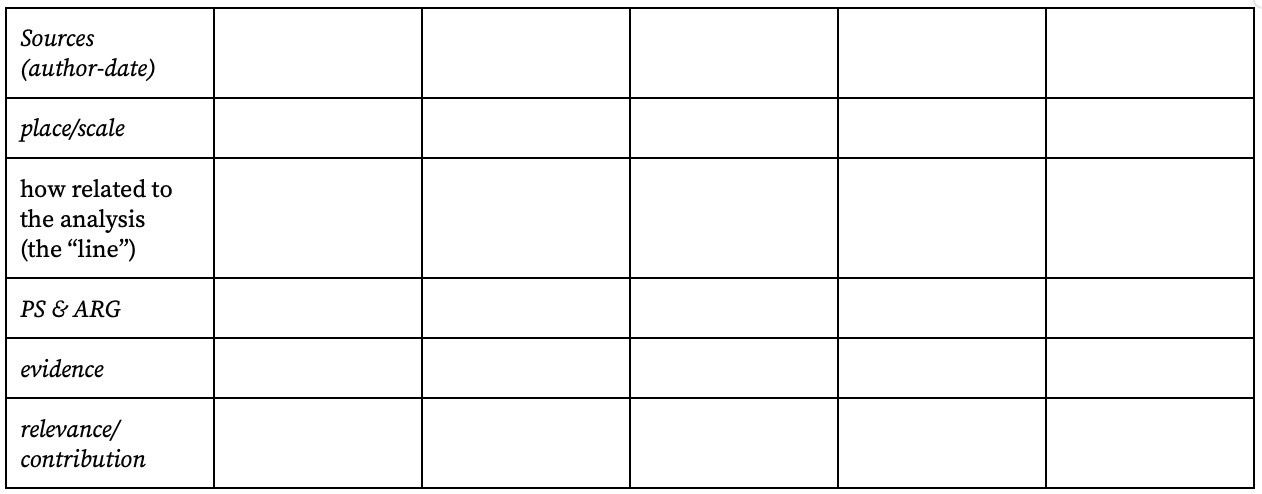
You will develop a small synthesis matrix as part of your annotated bibliography assignment:
Extracting structured information from sources
AI tools like Google’s Gemini Notebook can be helpful, so long as you use it to support synthesis rather than replacing you reading, writing, and thinking.
Extract structured information using Gemini Notebook
- Open Gemini Notebook and create a new notebook.
- Take the 4 (or more) PDFs from the previous searches and add/upload them to the notebook.
- We’ll work through the following 3 prompts together.
- Description: Tell the Notebook chat to:
Summarize these articles
Stop once you have a response.
- Analysis: Paste the following into the chat.
For each source, identify:
- the source itself
- the specific place, or the scale of the analysis, in China
- the main finding or argument
- the key theoretical concept(s), the framework used to analyze the research question or problem
- the biophysical factors supporting the analysis, such as topography, hydrology, climate, ecology, key species
- the human factors supporting the analysis, such as political, economic, cultural, or social factors
Present the results as a comparison table.
Note the difference this table has to a synthesis matrix.
Stop once you have a response.
Synthesis: Paste the following into the chat:
Compare these sources rather than summarizing them individually. Identify:
- claims or findings they broadly share;
- points on which they differ;
- differences in geography, scale, method, or evidence that might explain those differences;
- concepts that appear in multiple sources;
- questions that remain unresolved by this set of sources.
Cite the relevant sources for each observation.
Verify the extracted data
We will not have time for this in class, but the necessary final step is to return to the source itself to verify the accuracy of the AI extracts suggested for synthesis (claims, differences, questions, etc.).
Reflect on how your sources are working together to support your own thinking, and be sure you are guiding the research process rather than following AI output uncritically.
Reflecting on how we’ve used AI
AI was used here for a specific research operation, not as a substitute for reading, writing, or thinking through the research process.
| Problem | Possible tool |
|---|---|
| I need vocabulary | AI chat |
| I need relevant scholarship | Google Scholar, library databases |
| I found one strong paper | ResearchRabbit |
| I have many papers | synthesis matrix, structured extraction (Gemini Notebook) |
| A paper is difficult | interactively question the source PDF in Gemini Notebook |
| Citation management | Zotero or other tools |
● A bad AI workflow
Student: “Give me five academic sources about Airbnb and gentrification.”
AI: [produces 5 citations]
Problems:
- Do the sources exist?
- Why these 5?
- What was searched?
- What was excluded?
- Did you inspect the sources?
- Can you trace the claims?
● A better AI workflow
Give the system sources you have retrieved through iterative searching and related literature discovery. At least skim each one to be sure they’ll set the AI on the right track for your project.
Ask AI to extract structured information you can work with, such as:
- geographic case or scale
- main argument
- evidence
- actors or population
- key concepts or theory
- limitations
- information specific to your problem or question
Require page references, and verify the extraction against the source.
The verification rule
You must review the actual source material yourself, and cite the source you read (not the AI output), and be able to defend every statement in your annotation on your own.
AI output is not a source. It is a claim about sources. It is raw material for your consideration, not reliable polished thinking.
Annotation as a step toward synthesis
Annotations should do more than simply say a source is “relevant” or “useful.” An effective annotation should help you with synthesis writing by explaining how a source will contribute to your analysis and argument:
- Describe & analyze: What question or problem does the source address (PS)? What argument does it make (ARG)? What evidence supports that argument (EV)?
- Evaluate: What is especially useful, distinctive, or limited for your research? What does this source contribute to your research problem? What matters about this source’s approach to place, concepts, method, or evidence?
- Connect: How does this source change your project, vocabulary, question, or understanding of other sources?
Think of annotations as a bridge between understanding a source on its own and connecting that source to others, as it might appear in a synthesis matrix.
Weak annotation:
This article discusses Airbnb and gentrification. It will be useful for my essay.
Analytical annotation:
The authors compare tourism-driven neighborhood change to conventional residential gentrification. Their concept of touristification gives me a more precise term for a process I called “Airbnb gentrification.” The case doesn’t match my city directly, but the distinction between property conversion and resident displacement may be helpful for understanding touristification as gentrification.
Wrap up
- Review the China Gazetteer Annotated Bibliography assignment, due Friday, October 9
For next class
- We’re expanding the discussion of identity and place from cultural to political geography. Pay close attention to how the process of ethnic territorialization played out in a Tibetan area of Sichuan Province since 1950.
Footnotes
ResearchRabbit. “Citation networks: how to find papers you’d never discover with keyword search.” 23 June 2026. https://www.researchrabbit.ai/articles/find-papers-with-citation-networks↩︎