4.2 Discussion
Ethnicity, Place, and Territory 1

Lewu Village, Liangshan Yi Autonomous Prefecture (2019). Source.

Today
- Discuss the relationship of ethnic and national identity in China with place and territory.
- Discuss minzu shibie and its spatial effects.
- Synthesize Joniak-Lüthi and Yang.
Reading Responses
Minzu shibie 民族石壁 (Minzu identification)
The creation of minzu is a vital part of state-building in contemporary China, a transition from a ‘traditional empire’ to a ‘modern nation-state.’ (Yang 2009, 774)
Three phases, from the 1950s to 1980s:
- 1950-1953
- 1950-1952 CCP visiting delegations to ethnic areas, a “rehearsal for minzu identification” (Yang)
- the 1953 Election Law promised that at least one representative seat would be awarded to each minority group regardless of population size
- first National People’s Congress planned for 1954, with 1200 seats scheduled, 150 for ethnic minorities
- the first national census (1953): name, age, gender, relation to the head of household and their minzu status
- 400 minzu candidates identified, precipitating a political crisis of representation
- 1954-1963
- minzu classification project begins
- social scientists worked with state infrastructure to resolve the crisis: “seeing for the state” (Mullaney)
- “The Classification…did not include ‘ethnographic inquiry into the minutiae of everyday life and local custom’, and neither did it constitute ‘perhaps the most extensive series of fieldwork projects ever conducted anywhere on earth’. Rather, it involved a rapid succession of brief interviews with very few representatives from each of the applicant groups: anywhere from a few hours to at most a few days, and involving anywhere from one interviewee to perhaps ten at the most.
- “…the goal of such interviews was always one of convincing the interviewees to agree with those minzu categorizations which had already been developed and formalized by Chinese ethnologists and linguists before the start of the Classification, and even before the foundation of the People’s Republic of China. Thus, even in this explicitly political aspect of the project, the central importance of the social scientific contingent remains highly pronounced. (Mullaney 2010)”
- second national census (1963)
- 1964-1987
- 1960s Cultural Revolution targets destruction of traditional culture, regardless of minzu
- 1987 state announed minzu identification was complete
Ethnic autonomous regions
Ethnic categories would be the basis for some territorial administration decisions, though not tied directly to minzu shibie
- 1947: Inner Mongolia Autonomous Region
- 1955: Xinjiang Uyghur Autonomous Region
- 1958: Ningxia Hui Autonomous Region
- 1958: Guangxi Zhuang Autonomous Region
- 1965: Tibet Autonomous Region
- Plus autonomous prefectures and counties
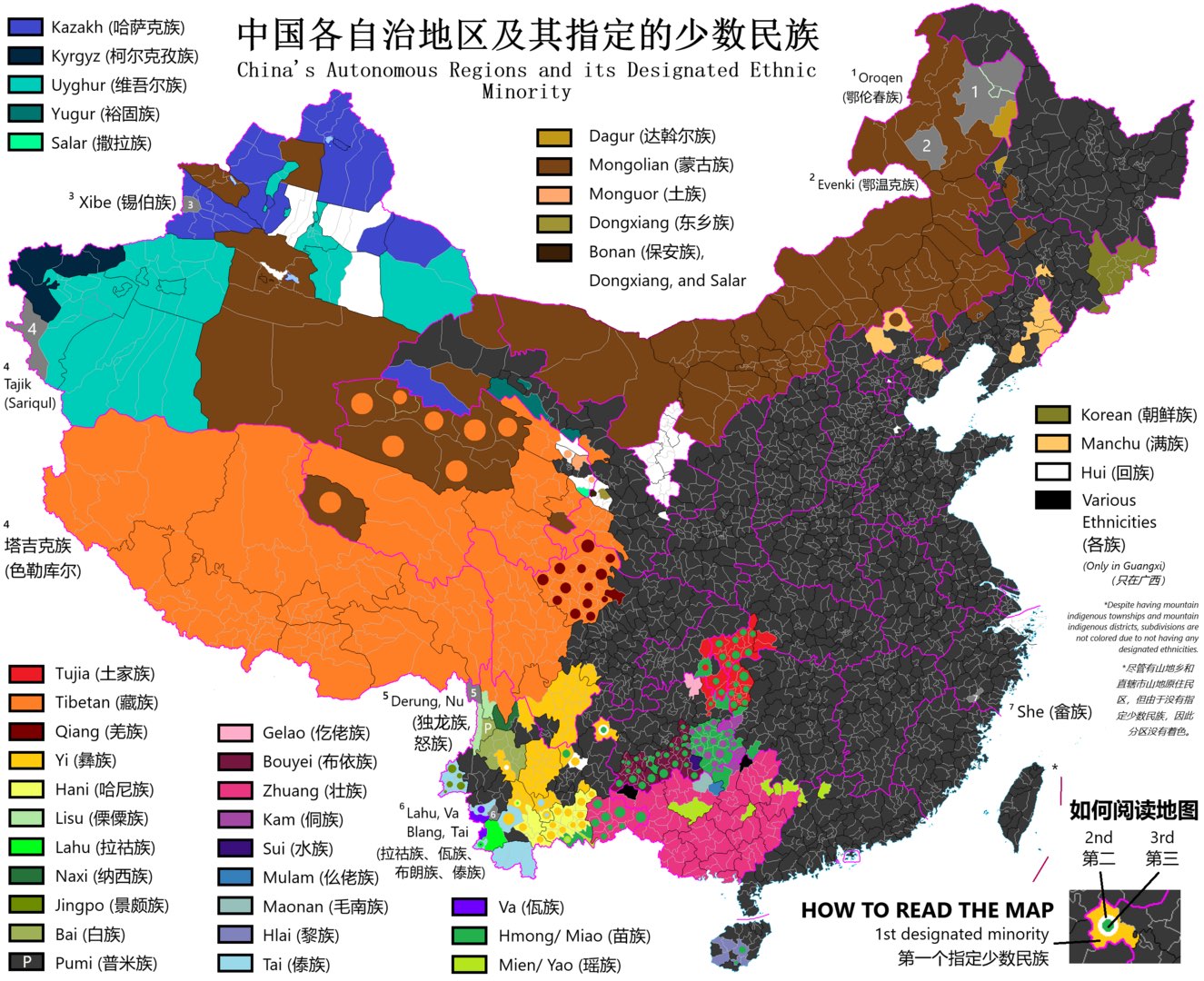
China’s ethnic autonomous regions 自治地区. Source.
Synthesis Reports
- Zifei W.
- Yijun S.
Synthesizing Joniak-Lüthi and Yang
- In your group, and using the synthesis table handout as a guide, complete the two reading-specific columns together. Both authors have something to say about how ethnicity is spatial.
- Once you have gathered enough relevant details together, take time on your own to consider the central question. Use each reading to generate something new – a new insight, question, or connection – that helps you think about the relationship between ethnicity, place, and territory.
- Take another 10 minutes to share your synthesis with your group. Explain how you generated an original idea from these two readings, and ask for feedback on how clear and/or convincing your synthesis is. Make some notes about what they say, and what was easy or difficult about this exercise for you.
Wrap up
- China Gazetteer Annotated Bibliography due Friday, October 9
For next class
Next class will be a Research Workshop focused on the development of your Environing China topic and supporting research. Please read the Synthesis Writing guide before class.
Weekly Summary
References
Joniak-Lüthi, Agnieszka. 2013. “The Han Minzu, Fragmented Identities, and Ethnicity.” The Journal of Asian Studies 72 (4): 849–71.
Yang, Bin. 2009. “Central State, Local Governments, Ethnic Groups and the Minzu Identification in Yunnan (1950s – 1980s).” Modern Asian Studies 43 (3): 741–75.